Entry objectives and a fixed exit validation
Freeze entry identity before exit-adjusted measures are used to validate or reject it.
The objective identifies what is being learned
An entry model has a declared causal learning or ranking objective. Return, profit factor, win fraction and holding-period drift after applying an exit measure another object. Allowing those later measures to define entry identity can silently convert an entry experiment into a combined entry/exit search. The canonical research policy keeps raw causal boundary recovery as the entry objective and freezes entry identity before applying a selected exit. This page explains that separation without changing it, building an asset model or claiming that the website's synthetic crossover is a calibrated proprietary entry candidate.
Exactly one predeclared exit keeps the question fixed
Choose and record the applicable exit policy before financial evaluation under the authorised method. Exit-adjusted results can validate, reject, size or measure overlap, but should not retroactively choose the entry objective. Do not reopen a tournament of stops, targets and holding clocks after validation or forward data is viewed. A separate new research hypothesis can be recorded with its exposure acknowledged. The teaching packet has one time exit fixed for a mechanics test. It contains no entry training, parameter optimiser, alternative exit contest or unseen market validation, so it cannot be used as evidence that this research-policy gate passed.
A completed identity boundary
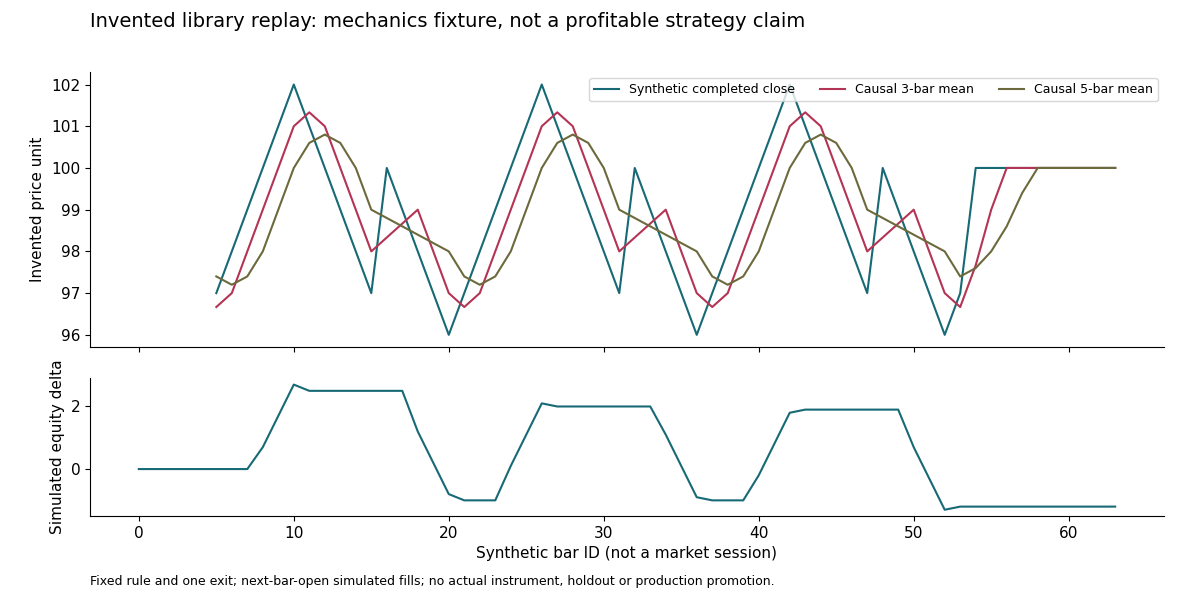
The source launcher freezes 3- and 5-bar rolling windows, one-unit entries and the time exit. A changed stop or window would produce another setting/source identity, even if the same example name were retained. The checksum map can show changed bytes; it cannot prove when the researcher decided to change them or what outcomes were already known. The negative 1.20 cash total stays attached to the original fixture. Selecting a more profitable synthetic variant and calling it an independently validated entry would confuse software illustration, economic evidence and the real decision history.
Native policy and the full process remain authoritative
An actual instrument task needs appropriate data routing, frozen dependencies, warmup, periods, calibration and independent master requirements. A missing new-asset integration is part of that task, not permission to erase identity guards or route it through an unrelated class. Native minute exits and whole-position/maximum-hold ownership remain separate from the tutorial's chosen time rule. No daily stop manager or production promotion is created by this article. A verified no-model result can be complete under the actual full process; a few software fixtures or an attractive replay do not supply that completion.
Filled invented system case
The fictional teaching specification has a fixed 3/5 crossover and one three-completed-bar time exit. It has no trained entry identity or financial holdout. A visitor proposing another exit after reading its negative result must label that as a new fixture choice, not a second independent validation of the original. Neither version would become a canonical instrument model, alter the raw causal entry objective or satisfy a separate master merely because the simulator runs.
| Object | Record | Bounded finding |
|---|---|---|
| Entry objective | Canonical causal objective in real research | Not defined by exit P&L |
| Teaching entry | Fixed 3/5 crossover | No training |
| Exit | One predeclared time rule | No tournament |
| Master/promotion | Different full evidence required | Not supplied by fixture |
Primary references and scope
Expanded source review: 13 October 2026. Documentation supports the stated mechanism, not a tested account, hypothetical fill or provider outcome.