Warmup and future-suffix invariance
Test which observations an indicator and decision may consume without claiming an independent market sample.
Warmup changes the evaluated population
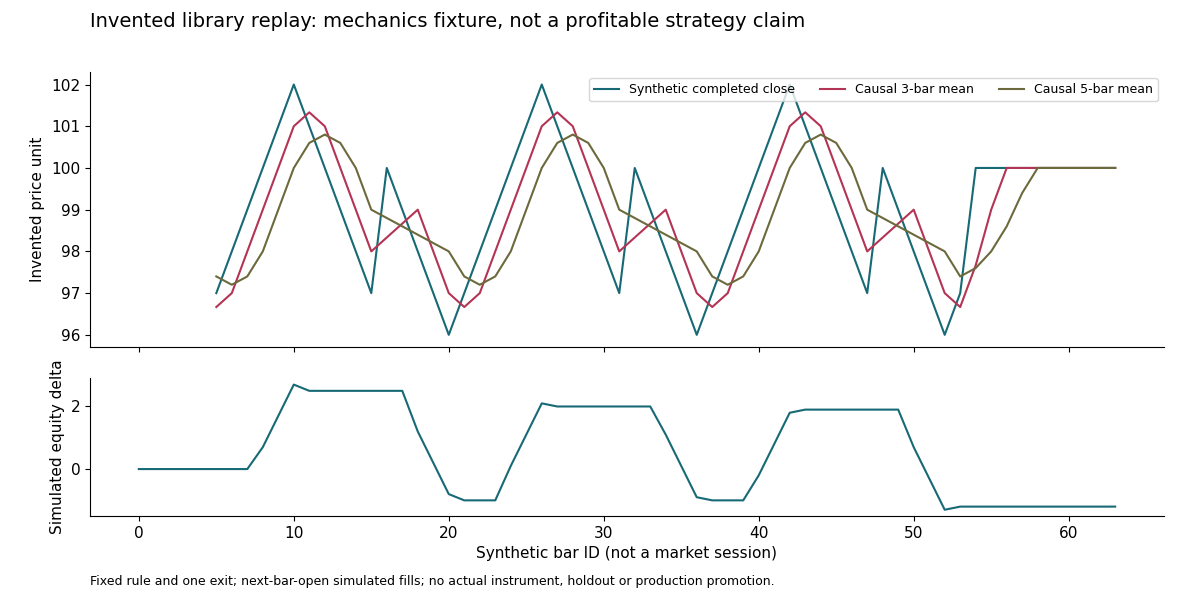
A rolling mean cannot be treated as valid before its intended past window exists. The example has 3- and 5-bar causal means, and the library's first decision is bar 5. Earlier CSV rows are warmup observations, not eligible system outcomes. A library may start one step after the first nonmissing indicator because a crossover also needs a preceding value. Record the observed start and explain the actual rule. A longer parameter window can change which dates or events are evaluated even if another setting shares the same nominal input file. A fair comparison cannot ignore that population change.
Precomputed does not automatically mean future-aware
An engine may precompute an indicator on a full array while revealing only the current prefix to a strategy. The transformation itself must still be causal. A rolling past mean can satisfy that contract; a centred window, future-filled gap or scaler fitted on reserved observations may not. Do not infer causality merely from the library's interface or an attractive chart. Preserve transformation code, window orientation, fitted scope and missing-value policy. The teaching reference uses past rolling means, while a separate Decimal check reconstructs each available value from exactly the preceding declared window.
Change later values and compare earlier decisions
The fixture makes four labelled suffix mutations after bars 14, 25, 37 and 49. All earlier indicator and decision records must remain equal. The later rows deliberately change while the prefix is retained, allowing a bounded check of future sensitivity. A changed future source may legitimately change later orders and cash, which are not required to remain equal. The test is not a new financial validation period, and repeated prefixes are not independent market samples. It establishes the tested implementation's behaviour under those specific mutations, not immunity to every possible timing defect.
Warmup crossing a real boundary needs a rule
An actual reserved evaluation may use earlier observations for causal state while excluding their outcomes from scoring, depending on the predeclared method. Open positions, overlapping labels and source revisions also need handling at the boundary. The synthetic packet supplies no untouched economic holdout or real market. Its first eligible bar and buffer tail are fixture mechanics only. Keep a real evaluation's data, exposure and selection history separately. A passing suffix test cannot repair a missing point-in-time source or prove that a researcher never used the reserved results when selecting parameters or an exit.
Filled invented system case
The fictional input has 64 bars, but decisions start at 5. A 3-bar mean at decision i uses closes i-2 through i, while the 5-bar mean uses i-4 through i. Changing every later bar after cut 25 by an invented price offset leaves all decision records through 25 unchanged. That passes a software-prefix check only. There is no independent unseen market segment, audited return or evidence that a real instrument's historical observations were available at those times.
| Object | Record | Bounded finding |
|---|---|---|
| Warmup | Input bars before decision 5 | Not scored outcomes |
| Fast window | i-2 through i | Past and current completed close |
| Slow window | i-4 through i | No future close |
| Suffix checks | Cuts 14 / 25 / 37 / 49 | Earlier decisions unchanged |
Primary references and scope
Expanded source review: 13 October 2026. Documentation supports the stated mechanism, not a tested account, hypothetical fill or provider outcome.