When a bar touches both stop and target
Record the unresolved path and engine priority rather than selecting the favourable fill.
A bar summary can omit event order
An OHLC bar records summary prices, not every transaction in chronological order. If a long entry is 100, stop 98, target 104 and the bar spans low 97 to high 105, both levels can lie inside the summary. The summary alone does not establish which was reached first after the relevant entry or whether an order was active at that time. A generic choose-the-profitable-price rule would add information not present in the source. A finer event record or a predeclared conservative engine convention is needed before a single exit can be interpreted.
Read the exact engine and order contract
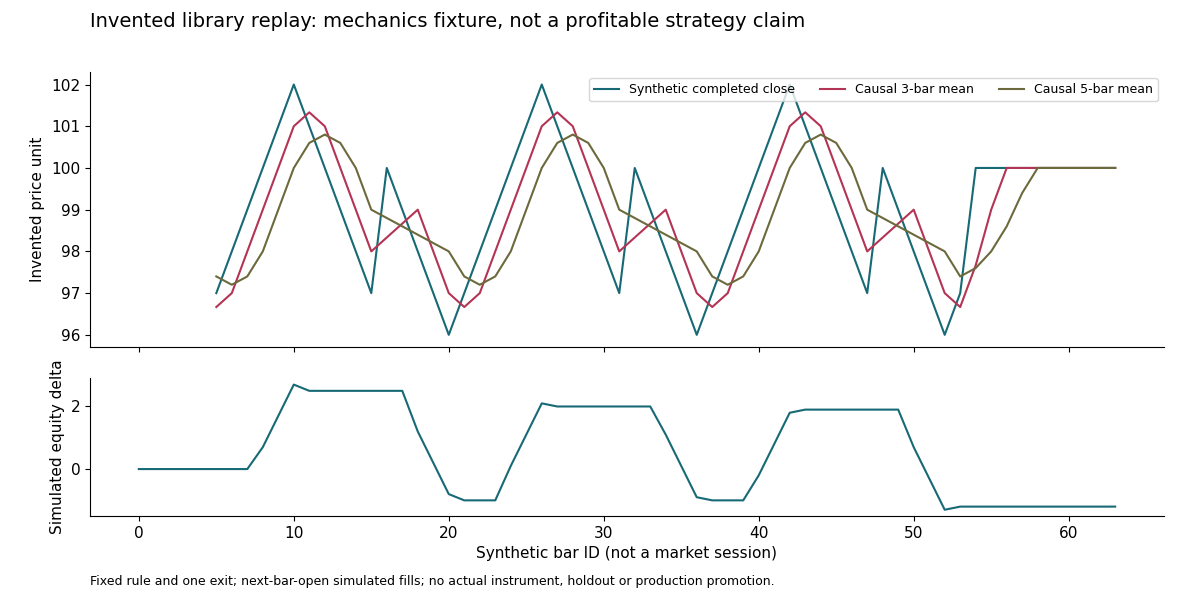
A simulator has specific rules for contingent orders, new entries, gaps and ambiguous bars. A current manual is a starting source, while the pinned version and a targeted fixture establish the behaviour actually used. Do not generalise one engine's rule to all brokers or instruments. A stop trigger also differs from an actual execution, and the intended target may never have filled. The BATS reference deliberately uses one time exit with next-open fills, not competing intrabar stop and target orders. It therefore cannot be cited as a test that resolves every contingent-order ambiguity.
A completed source-bound scenario
Keep the same invented OHLC record and calculate the two conditional amount branches separately. A stop-price liquidation at 98 gives negative two price units per held unit before costs; a target-price liquidation at 104 gives positive four. Neither is selected as observed truth. Assign no probability without evidence. A real transaction study would need entry activation time, order state, actual event or tick path, fills, fees and complete eligible positions. The two conditional calculations explain the missing object instead of pretending a favourable historical curve establishes the order of events.
Do not reopen the exit choice after evaluation
The treatment of ambiguous bars belongs in the frozen execution policy before a financial evaluation. Choosing an optimistic priority only after seeing whether it improves the holdout changes the experiment and exposes that period. Preserve the old source, policy and result if a correction is necessary. An implementation test can show deterministic priority without proving it realistic in a market. The actual canonical method and native exit owner remain separate from this teaching discussion. No daily profit floor, new proprietary stop manager or alternative exit tournament is introduced by explaining the two unresolved branches.
Filled invented system case
The invented long has entry 100, stop 98, target 104 and a summary bar low 97/high 105. Conditional stop-price change is negative 2; conditional target-price change is positive 4. The packet contains no event order or transaction evidence, so the completed finding is path ambiguity rather than a winning trade. The BATS library fixture uses only its declared time exit and does not test this contingent-order case as if it were a real broker fill.
| Object | Record | Bounded finding |
|---|---|---|
| OHLC range | Low 97 / high 105 | Both levels inside |
| Stop branch | 98 - 100 | -2 per unit before cost |
| Target branch | 104 - 100 | +4 per unit before cost |
| Chronology | Not supplied | No favourable branch selected |
Primary references and scope
Expanded source review: 13 October 2026. Documentation supports the stated mechanism, not a tested account, hypothetical fill or provider outcome.